Monday, 3 December 2012

Shoe Review: La Sportiva Crosslite XC

As the upper in my previous right trail shoe decreased its attachment to the lower portion of the shoe, I started to look out for a new model and brand.  Nic has been quite happy in her choice of La Sportiva Crosslites for several hundred miles, but when I tried a pair, the fit wasn't really what I was looking for.  I've been wearing Inov-8s since 2008, which makes it tough for anything new to get past the "first impression" test. I liked the upper and the rock plate, but something wasn't quite "right".  So, when I had the opportunity to try on a pair of Crosslite XC at the Snowdonia Marathon mini-expo, I took the chance and was pleasantly surprised.  The next thing I knew, I had a pair of shoes tucked under the wardrobe waiting for the untimely demise of my Roclites.

After my trip to the Wrekin last month, the time had finally come to try something new.  Carrying my new shoes in my backpack, I ran for my favourite proving ground - Bredon Hill.  My preferred approach up the hill begins with a steady track around a ploughed field, carries on through a firm pasture, slogs through a load of boggy muck, up a wetland that was like a shallow stream after all the rain, up a limestone track, and along a path that alternates between grass, slippery roots, mud, and rock.  Then it's a nice circuit of the hill and back down.  In a little over 7 miles, this route offers a fantastic mix of terrains and textures to test out a new pair of shoes.

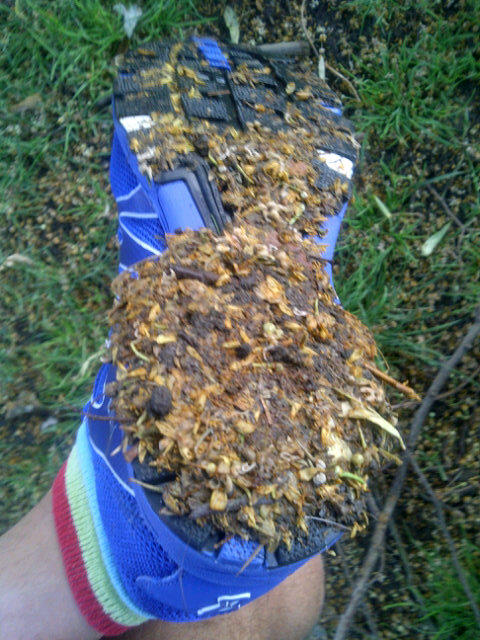
The Crosslite XC is a light shoe (less than 280g in size 9) with a breathable upper, aggressive outsole, and lace gaiter.  Thankfully, the bright yellow mellows quickly once you hit the mud.

La Sportiva Crosslite XC - "Before"
The first thing you notice when you put on the Crosslite XC is that you can't get to the bottom of your laces.  Adjusting the tension requires an old-fashioned tug on the ends and some hope that you'll get it right.  It took a few tries, especially with cold fingers (I'd had a nice, if very cold, road run to reach my testing ground).  After a couple of stops, I got the laces right and was able to tuck them into the gaiter.  The gaiter comes up high enough to provide a good anti-muck layer above the most vulnerable grit access point, but not quite far enough to allow you to completely hide the knots.  Being able to tuck away the loops in the laces should help to keep the shoes from being untied by running through long grass, but the knots still get caked with mud as you find with any other shoe that needs to be tied.

The rubberized toe box and reinforced upper proved suitably robust against the various rocks, sticks, and roots I encountered on my way.  My feet kept reasonably dry when running through small amounts of mud, and the shoes seemed to drain quickly when I went through anything particularly deep.  I never felt like the shoe was holding an unnecessary amount of the water I was running through.

Widely-spaced lugs, angled to support ascending and descending.
The Crosslite XC is billed as an aggressive fell and trail shoe, designed for wet and slippery conditions.  The outsole bears out the description.  The lugs are angled in all directions to support forward motion - the outer lugs on the forefoot are angled to resist sliding away from the centre line, the main forefoot lugs are angled to grip and pull through as you go up hill and to push mud away as you go down hill, and at the back you can see the lugs turned around, so they offer extra grip as your heel digs into the shifting earth/scree on a messy descent.  The "FriXion" rubber compound is a soft rubber, ideal for wet rock.  The grip on wet limestone descents was unexpectedly good, comparing quite favourably to the popular Inov-8 Mudclaw. The harder sole on the standard Crosslite is not quite as sticky across wet rock, but wears well on the road sections of a route - I'm not sure how long the XC will cope with the inevitable road running between trails, but the extra stability on wet limestone is worth it on my local trails.  I felt incredibly well connected to the ground on my descent through wet leaves, rock, roots, and grass, with good grip throughout.

The rock plate and rigid sole provided excellent protection from the occasional sharp rock, but the difference  from the incredible flexibility I normally have in my shoes may take some getting used to.  I can think of several races over the past year when I would have loved the extra protection, so I'll be breaking myself in as quickly as possible.
They wash up well in running water, and don't keep it with you  once you carry on.
Towards the end of my run, I tested the built-in gaiters with a knee-deep mis-step.  Very little filth got into the shoe, which made a nice change from my previous pair.  I did manage to sweep some grit into the shoes as I washed off the mud in a stream, but nothing more than could be expected with the vigour of my swishing about.  Happily, the shoes also released the water as I ran, so there was no squelching after just a field or two.


As I sat to change back into road shoes for the 10K run home from the test, I encountered an unexpected bonus.  Although I hadn't really noticed the fit once I got the lace tension right, the Crosslite XC heel box fits me perfectly, with no slipping.  My feet typically tear out the heel box cushioning in all of my shoes, but these gripped in just the right places - to the extent that I struggled to get the slimy things off my very wet feet!

In summary, the Crosslite XC is an excellent fell shoe, great for wet and slippery conditions, with a great fit.  It handles rough terrain as well as its better-known rivals, and feels like it will last a bit longer.  It seems like La Sportiva are phasing it out (I can't find it on their website any more), so it's worth stocking up before they disappear entirely.  That said, based on my experience so far, I'd happily consider any new light-weight replacement the manufacturers come out with.

Mid-life update: 
It's nearing the end of February, and I've put nearly 200 miles on these shoes, so I thought it useful to update the review. Mostly, I have been running in mud - up muddy hills, down muddy hills, through wet and muddy fields.  The longest I've spent in the shoes is around 6.5 hours.  They really do drain well. I've managed 1 dry run in that time, and the shoes held up well.  My feet didn't get too hot, but I must say that after 20 miles, I was feeling a bit battered by the combination of already-tired feet, minimal cushioning and the fairly rigid sole.  I'm quite happy to run on a minimally cushioned shoe, but I would have liked a bit more freedom for my feet for a run of that distance given the amazing lack of soft ground on that day.  

As with nearly every shoe I've worn this winter, I am seeing some heavy wear around the toe box.  But, unlike my Inov-8s, I haven't had any holes developing in the Crosslite XC.  The fabric is pretty robust.  The test will be whether it separates from the sole after another hundred miles.  So far, the signs are that the shoe will last well.

I still think this is a top-notch shoe, but I can't see wearing it for any of the 8-12 hour events I've got coming up in the spring.  But, since that's not what the shoe is designed for, I won't complain about that!


Sunday, 18 November 2012

The Wrekin Wrecker - a bit of spontaneous fun in the sun

This week, I've mostly not felt like running.  It doesn't happen often, but when it does, I listen to my body and get in a bit of extra rest.  The benefit of occasionally taking a break is having the energy to get out and throw in an extra race as a reward!  So, with friends Mitch, Roy, and Chris, I headed out to run all 'round The Wrekin.  I had missed out on the race last year, due to injury at Abingdon, so was happy to have a chance to try it out this year.

This race is a category A fell race, which means it's steep (average 50m/km of climb).  It also means there will be plenty of top class competitors there to make sure I don't get lost as I follow their footprints.  The route was very well marked, well marshalled, but could have done with a few more slow runners to pad my ego when I look at the results.

We started in the middle of a wood with temperatures hovering around 4C and quickly headed along a narrow, undulating track before the first ascent of The Wrekin.  It wasn't particularly difficult, just a case of getting up by alternating between a run and a fastish hike.  By the time I hit the top, I was warm, but wasn't about to take off my gloves or headwear - I wanted a little extra protection in case I took a tumble on the rather steep scree slope that was just around the corner.  On top of the hill, the sun was shining bright and I briefly considered the decision to keep my shades on my head to have been correct.  Then, we were back into the woods and they started to bounce along as the route headed down the hill.

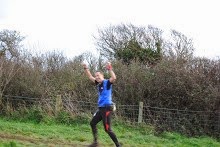
It's been a few months since I've raced hard in the hills, and it showed.  My feet weren't moving as quickly as I would have liked when I got to the scree slope, but I managed the first half quite happily.  The sliding, jumping over roots, and general high-concentration, high-turnover descent was a lot of fun.  I did cop out at about half way and steady myself against a tree, trying to clear my eyes that were watering from a mixture of cold air and adrenaline.  Unfortunately, shortly after I resumed my run/shuffle/ski/jump down the hill, I found myself facing up the hill, sliding feet-first towards the bottom, somehow having pitched forward, landed on my side, rolled onto my back, and then onto my front as I tried to stop the slide and get back to my feet.  I expect it looked spectacular, but it also left my shades a few yards up the hill and I had to trudge back up to get them.  Mitch looked up when he got to the bottom in time to see me stand up, arms aloft, as though I had just completed a fantastic dismount from the pommel horse.  It wasn't the most serious fall, but apparently it had style!

The next couple of miles, gently climbing, were pretty unpleasant.  I'd winded myself a bit in the fall, and found it a struggle to run much faster than a gentle jog.  When we reached the 1:3 clamber back up the hill, I was feeling pretty beaten up by the course.  Still, by 4.5 miles, we had 2 of the 3 ascents complete and it was due to be plain sailing, surely.

Once again, we headed down the hill and into the woods.  The track was a little less steep than the previous ascent, but full of roots, rocks, leaves, and other obstacles to keep the mind sharp.  The final climb was steep and steady, but by then I was starting to feel OK again and just worked along with the group of runners that had been catching me since my fall.  The final descent was incredibly challenging and full of trip hazards, and I would have loved to watch some of the more experienced fell runners as they passed me.  I caught glimpses of very fast-moving legs, but mostly tried to focus on where my slightly plodding feet were going to land.

Finally, with a mile or so to go, we were back onto normal, undulating trail, and I was able to pick up the pace and try to pull a bit of time back and finish 71st, around 1/3 down the field.  I enjoyed the mini buffet at the end while cleaning my wounds and waiting for the results.  All told, a bit of fun, a bit of sun, and a race I may just go back and try to finish without hitting the deck.

Saturday, 17 November 2012

Shoe Review: Inov-8 F-Lite(tm) 230s - the new marathon road shoe?

On January 1st, 2012, I entered the Snowdonia Marathon.  A few weeks later, I bought a pair of Inov-8 Road-X(tm) 233s, with the intention of easing down another 3mm of heel drop in my road shoes.  With a spring full of trail racing, the 233s lasted longer than expected, with only around 400 miles on them as summer came to an end.  And then I looked at the course and the location again, and realised that I would never be able to blast down a wet, grassy, slippery, rainy trail in a shoe with virtually no traction on wet grass.  They would be great for 24.5 miles of the race, but the 1.5 miles where I intended to recover nearly all of the time I would lose on the final climb, so I needed to be certain of my footing.  What to do?

After searching for a low profile shoe with a bit of grip in a brand I could slip straight into, I opted to run my annual road marathon in trail shoes.  After all, I'd run almost all of my long runs during the year in trail shoes, so why not? That brings me to the F-Lite(tm) 230s.  The 230s are listed on Inov-8's website as a fitness shoe that's also designed for hard-pack trails and tarmac.  Oddly, though, they aren't listed among the Inov-8 road shoe range.  So, I checked with SouthLakesGuy on Twitter (he knows a bit about Inov-8s), and he confirmed they are great all-rounders.  I only had two concerns before they arrived - the outsole and the upper.

Comfy, close fit across the toes - no problems with the fit!
The F-Lite 230s are, strangely, heavier than the Road-X 233s which are half a size larger (249g size 9 vs 240g size 9.5).  Admittedly, the Road-X has had a bit more wear and is losing bits of fluff out of the heel padding, and the F-Lite is now holding a little bit of dirt in its tread, but the difference is a bit of a surprise, given Inov-8s numbering system.

The F-Lite sole is incredibly flexible, to the point where it felt like they would bend any direction my foot wanted to go.  When I wore them on a 21 mile practice run, it was like going out in my slippers - I could feel every bit of road.  To me, that's a good thing. It has a little bit of tread, in Inov-8's sticky rubber compound, but nothing overly agressive. So, the outsole passed the initial test.

Recently, the uppers on my Roclite(tm) 285 trail shoes have shown a bit of weakness against the strain across the forefoot, tearing away from the toe reinforcement on my right foot.  The 230 upper, with a less rigid reinforcement, molds better to my foot and fits much more like the Road-X, so has not had the same problem.  My worry that the upper wouldn't survive the training proved unfounded, thankfully.
 Update Jan 24, 2013: Amazingly, with less than 400mi on the clock, the upper has separated from the lower.  It's so disappointing, because these have been great on the slushy pavements and snow.  Yes, they're getting on a bit, but I'd rather hoped the upper would last as long as the sole, since I have been almost exclusively on the road with these.  This seems to be an undesired and recurring issue.
F-Lite upper & lower separation.

So, the shoes seemed fine and dandy, but how did they do on the day?  First, having very little weight on my feet over the course of 3.5 hours was great.  The less my legs had to pick up, the better.  Relative to the 233s, it's not much difference, but the alternatives I'd been looking at were in the region of 30% heavier, which starts to count after a while.

I have tested the 230s on wet grass and mud, and they are more effective than the Road-X, but I wouldn't advise taking them on a long muddy run, as they really have only as much grip as any standard road shoe would in the conditions.

The F-Lite(tm) heel held onto wet blossom really well, but see how the forefoot stayed clean.
Comfort-wise, I caught a sharp rock at about 5 miles and briefly wished for a shoe with a rock plate as I continued racing down the rocky path.  The pain dissipated once the route took us back onto the road, but the rocky track wasn't very nice.  I like to feel the ground when I run, but if you're going to spend more than a mile or two on rocky trails, I would advise something a bit more rugged.  For pure road, the extra little bit of cushion under the balls of the feet you get in the Road-X is a nice change.

In terms of fit, of my 3 pairs of Inov-8s, the F-Lite fits best.  There are no pinch points like I experienced with the 285, and the heel cup fits much better than the 233.  There have been no hotspots or blisters with any of them, so that's not really an issue.

Overall, I would say I've got a new go-to road shoe for the winter. I hardly ever manage to stay entirely off the grass on a run, and the combination of fit, comfort, and traction put the F-Lite ahead of the Road-X in my book.

Thursday, 8 November 2012

Broadway Tower Trail Races - a view from the other side of the line

Normally, I only write about my own efforts or occasionally Nicola's.  Last weekend, for the first time in a while, I crossed the fence to the dark, hidden side of running: race directing.  The majority of that activity will remain dark and hidden - races are much like sausages: you enjoy them more if you don't see them being made.  But, here are a few reflections on the day.

Broadway Tower Marathon Start - photo courtesy of CM Running Photography

The routes for the Broadway Tower Marathon & Half Marathon have been under design for quite some time.  The original route was planned in the spring and in place early in the summer, with the diversion (the one I designed, not the unplanned ones) decided a bit more recently.  They include some of the most beautiful views the area has to offer, even on a rainy day.  On a nice day, the route can be absolutely stunning.  Over the past few years, these trails have been fantastic to run on, with occasional slippery bits and plenty of good hard-packed, often rock hard ground.  With the ridiculous amount of rain we've had locally this summer, some of the fields turned to sticky, muddy, horrible mires - especially in the 3rd quarter of the marathon course.  Having run nearly all of the route on the Wednesday and Thursday before the race, I am full of admiration for all of the competitors.  Conditions underfoot were tough out there on Saturday (but not a patch on how bad it was amid Sundays downpours!), and if the sun hadn't come out I dare say we would have had a regular transfer service running from the 20mi check point to the race base.

In every event, there are plenty of unexpected surprises on the day, for runners and organisers.  I can't imagine how difficult it would have been for everyone without the telephone safety net.  A few people needed some extra directions and reassurance they were on the right route and phoned to check.  A few probably should have made calls but didn't.  For anyone planning to run on the trails, whether racing or training, it's always a good idea to take a phone.  A quick text or call to say "I'm lost," "I'm OK, just really slow," "I'm really cold and need some help" can be the difference between a good day and a disastrous one.  Personally, I've used my phone for all of the above.  It's also worth knowing/remembering that a text message will send in low signal better than a phone call will connect.

I didn't get the chance to speak to everyone as they crossed the finish line, but I tried to catch up with as many as I could, and seeing the sense of achievement on so many faces was fantastic, and something I won't soon forget.