Saturday, 2 April 2011

CTS Sussex Marathon - Stage 6 of 8

The preparation for the latest Endurancelife event was pretty straightforward:  recover from the last one enough to make it to the starting line.  With only two weeks between Pembrokeshire and Sussex, I focussed on rest and rehab for the first week, rebuilding the little tweaks and tears that any race will cause.  I did a bit of light running in the second week, more for relaxation than for physical training.  My body wasn’t really in the mood to run, but we were due a sunny week and I was looking forward to some excellent scenery.

As anticipated, the morning dawned calm and hazy.  It wasn’t warm, but we were due to start at around 10 degrees and climb up to around 14 with some extra warmth if the sun broke through the mist.  Morning preparations went well, and I felt fully fuelled by the time we arrived for registration.  The only worry was that my legs felt like lead and I wanted a few more hours of sleep!  So, while I waited in the milky light for the race briefing, I found a nice patch of grass and stretched out for a cat nap.  Nic evidently found this amusing and kindly captured the moment for posterity.

Pre-race preparations


After what seemed like only a few seconds, but was probably a good few minutes of snoozing, it was time to get up and get warmed up.  My intention was to take it very easy in the first few minutes and then just take the day as it came.  I had no idea how my aching bones would cope with another day in the hills.

No need to hurry, the hills aren't going anywhere.


The course started at Birling Gap, in the middle of the “Seven Sisters.” The Seven Sisters are a series of short, steep hills on the English Channel coast, associated with the famous Beachy Head.  We headed west, taking in just over half of the Sisters on our first coastal section.  I’ve seen this iconic coastline on television many times – the stark white chalk offset by the blue sea, blue sky, and green grass.  It was invigorating to not just see it in person, but to be a part of it – to take on the challenge of the terrain and to appreciate its rugged beauty.


Looking back over Birling Gap towards Belle Tout Lighthouse

The course heading off across the Seven Sisters


The ascents were short and steep, and I hiked up most of them to conserve energy for later in the day.  The descents were built for speed – steep, generally soft under foot, and not too technical.  So, in typical fashion, I flew down the hills with arms and legs flailing and then slowed to a fast stomp once the momentum ran out on the uphill.  I was having so much fun, I even tried to get a few snaps on the way.  And, yes, I did actually exclaim “Wheeee!” on one of the more exciting drops.

This is what happens when you point the camera to the side on a fast downhill.

Steeply down followed by steeply up!

Plenty of hills to come
Only the leaders can run up all of these!

Green rolling hills just keep coming

Only a few Sisters left to go!

Wheeeee!!

Finally, the chalky Sisters are behind us


By the time we turned inland at around 5k, the field was completely spread.  All of the people I chatted with as we leapfrogged our ways up and down the Sisters were strung along the countryside.  I could see pairs of runners, but there were no more large groups.  I settled into a rhythm with the expectation of 24-25 miles of solitude broken only occasionally by the short exchange of running tales while passing or being passed.

Our trip through West Dean and the surrounding hills was fairly uneventful.  I reached the first check point at 5.5 miles feeling slightly better than I had at the start, but in generally high spirits.   The sun was occasionally shining, the wind was very light, and I was running comfortably enough in spite of the little aches and pains left over from my trip to Wales.  There was even a mile of flat running between Litlington and Alfriston (well, almost a mile).

Approaching Alfriston


From Folkington, the course turned south and back towards Birling Gap.  To get back to the coast, we had to climb back over a few miles of the South Downs.  As the coast neared, the wind speed increased.  The promised stiff breeze out of the Northeast was cool, but not overly unpleasant.  I donned my windproof vest that had been tucked away for the previous eight miles.  Happily, it never got cold enough to need a hat or gloves for the first time in months.

The long climb out of Folkington

Mist burning away on the South Downs.

The highest point in the race.


At about 11 miles, I started to figure out how far I would finish behind Nic.  She was running the half, which started an hour and a half after the marathon.  It’s funny how useful I now find all those irksome math problems from school that start “if a train starts from point A at 9AM, and another train starts from point B at…”.  Anyway, I guessed that I would finish 30-45 minutes after her.  Playing with the mental math and a few different scenarios kept my brain occupied through the final stretch of woodlands – there’s not much to see when you’re surrounded by trees.  It also confirmed that unless she was having a shocker, I wouldn’t catch her, so there was no point in trying to recover that amount of time just for the fun of passing her on the line.


At Birling Gap, I ran into (almost literally) the back half of the 10k as they started their race.  There was a small pinch point where we were going in opposite directions.  Thanks to those courteous 10k participants who let a fairly ragged and confused looking runner through! 

Next came the climb up to Belle Tout lighthouse, which had been shifted away from the eroding cliffs edge a few years ago.  This was a nice, gentle reminder that the remaining Sisters were still here and still steep.  On the way down from the lighthouse, the course turned directly into the ever-increasing breeze.  The remaining coastline became a trial against the wind, the hills, and general fatigue.

It was a long, slow climb up Beachy Head!

Beachy Head itself was a long, slow drag followed by a 1:2 descent.  I normally avoid leaning back on a downhill, but to lean forward wouldhave resulted in a very long and uncomfortable series of somersaults.  I ran / hopped my way down, barely in control.  By the time the gradient eased to a 1:3, I was still going too fast to open into a normal running stride.  It was easily the steepest descent I had ever successfully navigated, and was exhilarating.  It was also slightly exhausting, and I returned to a jog for the next mile or so while I recovered.  I was moving along easily enough, and sent Nic a message to say I’d finish somewhere between five hours and 5:15.

It wasn’t long before I left the coast again at Eastbourne, heading back up into the Downs.  For a while, the wind was again from behind and the sun gently shone.  The course led across the hills towards Birling Gap for a little over a mile.  Then we turned south towards the coast, and then again east back towards Eastbourne.  This little inland loop existed to make up the mileage, but the open downland provided some pleasant surroundings. 

There weren’t any flat sections, just up and down, into and out of the wind.  At 20 miles, I started to feel light-headed.  I realized that I was fast-approaching The Wall.  I had planned to take my final gel at around 21 miles anyway, so I downed it with plenty of water and slowed to an easy walk for about 5 minutes to give my body a chance to process some of the sugars floating around my bloodstream.  The south-bound segment started with a nice steady downhill, so I eased back into a run while I had gravity on my side.  I started to feel better, and was able to keep a reasonable pace until the turn back into the wind at 23 miles.  The wind pushed me to a slow trudge, and then a long, exposed drag broke me.  I dropped back to a walk and sent Nic an update that I was going to be an extra half hour, given how things were going. 

My experience of these races has led me to plan for a 28 mile run, regardless of the official distance.  At Pembrokeshire, I felt like rubbish for the last four miles, always thinking that it wasn’t too far to the finish, so I might as well just push on.  In the end, I lost quite a lot of time in those four miles, and finished completely wiped out.  With that in mind, I opened my “emergency” pack for the reserve gel and took it.  Gels normally take about 15 minutes to have an effect.  At the pace I was moving, that would give me some benefit at 24 miles.  With luck, I would also be moving from the simple sugars of the previous gel to making use of the complex sugars at about the same time – a double boost.

Just before the 24-mile checkpoint, Nic sent me back a message to say that she’d finished the half, and the final 5k was basically flat.  So, as I climbed to the checkpoint and watched the paragliders launching themselves off the cliffs, I held out hope that I was nearly over the worst.  The marshals confirmed that only a little over 3 miles remained (only 27 miles this time!), and I started to feel human again.  We headed down towards the road, and I saw the earlier treacherous drop from the top of Beach Head off to my left.  At that point, I realised that we would not re-climb that monstrosity, and cracked a grin.  Obviously, the sugars were also starting to work, because my improved mood coincided with improved pace.

The course carried on along the lower portions of the cliffs, and my legs started to feel strong.  I eased down the last steady hill at a good run, texting Nic as I picked my way among the gorse, to let her know I was running again and would finish soon.  The bad patch well and truly behind me, I pushed the pace for the last two miles, knowing I would have three weeks to recover.  With the stiff wind now at my back, plenty of gentle downhill, and refuelled legs, the finish came quickly. 

Speeding to the finish!

Looking back, those last two miles were two of the three fastest of my race.  The tailwind made an enormous difference.  And, with the help of a little sugar and water, I managed to recover the 5:30-5:45 I’d anticipated when everything was falling apart and finish in under five hours.  Mentally, the race was as difficult as any I’ve done.  It was made a little easier by also being one of the most scenic courses I’ve experienced for any distance.  And completing it in a good time gives me confidence that I might just manage the stupidly hard Exmoor (5/5 on the difficulty scale) in a sub-6 time.  Bring on the recovery, and bring on the next race!

Friday, 18 March 2011

Perspective in Pembrokeshire

It's very easy to get lost in the training, racing, and recovering that comes with running.  In fact, that's often the reason why I do it.  I can put the mundane stresses of the day into "the grand scheme of things" and regain a bit of perspective on life.  Running can be the tool to regain a sense of my place in the world.  During the past weekend's marathon activities, though, running itself was put in its place.

I work for a Japanese company.  I have some fabulous friends and colleagues in Japan.  So to hear and see the news from Japan on March 11th as I was preparing for my latest race took me out of my bubble and reminded me that although my place in the world can be quite nicely unobtrusive, every day life can be anything but "every day".  I watched, unable to help, as did most of us, as a wonderful nation was rocked to the core.  Not really sure what else to do, and thinking of my Japanese friends, who are some of the most resilient people I know, I lined up for the Pembrokeshire marathon.  I remembered the phrase that constantly keeps us going through the working week:  "Ganbatte o kudasai".  It's a phrase with myriad uses - usually encouraging, occasionally chastising, always exhorting more effort, more perseverance.  This phrase regularly pops into my head when I'd rather go home than finish something that must be done, or when I am 23 miles in with an unknown distance to go.  On Saturday, it got me to eat breakfast, get dressed, and get to the starting line.  If my friends could get through the hell of their island moving ten feet in a few minutes, I could certainly go out and run hard on my stationary patch of coastline.  With my little challenge in its proper perspective, I went out to do my best while trying to capture some of the beauty of the day to share.

We start from the harbour and head up to get a great view.


The race started in the seaside village of Little Haven, Pembrokeshire.  We snaked our way from the tiny harbour-front up onto the clifftops overlooking St. Brides Bay.  From the outset, the views were spectacular.  Each turn brought a new magical, rugged rockface running down into the deep blue water.
 
Climbing gently to the top of the cliffs
The course winds off in the distance.
For the most part, the hills were short and sharp, with long stretches of gentle trails in between.  The weather was cool but fine, so we encountered quite a few ramblers whose Saturday walks were continuously interrupted by mad people running past.  While we exchanged pleasantries, I imagined that the constant trickle of people passing on the occasionally narrow trails would become irritating by the time the half marathoners came past.  I could only hope the walkers had made it to the pub by the time the 10k race started a couple of hours later.

Walkers enjoy the paths and visits to the local historic sites.


This course is rated as the least difficult of the series.  Without the steep ascents of the other courses, we were moving at much closer to road pace than usual.  I kept seeing mile times in the region of nine minutes and thinking, "I'm not used to running this fast on the trails!"  I kept an eye on my heart rate, which was fine, and wondered how long it would last.  

Flat, more or less, with nice views inland and out to sea.
 
The course led south along the peninsula, and eventually across to and then around St. Anne's Head.  The bonus of this route is that we spend 2/3 of the time on the coast, and then cross the peninsula to return to the start.  Although I was pretty sure that most of my attempts at photography were doomed to failure, I had miles and hours to keep trying to catch some good pictures. 

After 10 miles, I took the decision to ease back a bit.  I felt good, but I could also tell that I'd not yet recovered from the last race, so I didn't expect to get through the day with anything like the strength I had in Devon. 

Thankfully, we ran by, rather than down to, this lovely bay.
 
An extra 30-50 seconds per mile kept me comfortable until we headed inland at Dale, 18 miles into the run.  The hill up from Dale was long and steep, and my abdominal muscles and groin began to tighten.  During this climb, I walked at an easy pace and massaged the soreness away. 

Up at the old air field on top of the peninsula, I carried on, but fatigue began to set in properly.  My lungs were fine and my heart rate was OK, but my legs just didn't really feel like going any more.  A gel at 19 began to help re-energize the muscles.  I kept reminding myself that I was here not just for fun, but to push beyond my perceived limits.  "Ganbatte," I told myself, and carried on.  My pace started to drop back to the normal plod of 11-12 minute miling. 

Nothing hurt, but nothing was in the mood to move, either.  The final few miles passed by slowly, beautifully, and happily.  I knew that I could get through eventually.  I also knew that, somehow, I had managed to keep a fairly steady pace.  Even as I jogged along, I was heading for around 4:50 for the 28 miles.  When I saw the final ascent, I also picked out a pink dot moving up it.  Nic was running the half, which had started when I was about 9 miles in, and I'd been half hoping to keep going well enough to finish with her.  But, at that stage she was nearly a mile ahead, less than a mile from the finish, and I wasn't getting any faster.  I sent her a text to let her know I wasn't far from the finish, so she would wait for me, and carried on.  Sure enough, as I dropped back down to Little Haven, Nic was cheering me on, fresh from her 16 mile "half".  No wonder I nearly caught her!

Welsh Daffodils in the sun

This week's marathon was hard work, physically and mentally.  It was also consistently beautiful.  I felt tired from start to finish and I drew inspiration from the strength of those far away.  I hope the pictures and story of my day out can provide some welcome distraction and escape for them, in turn.

Saturday, 26 February 2011

CTS South Devon Marathon - a perfect day?

The challenge continues, and this month's installment was a 27.5 mile jaunt through the Devon countryside.  I'd never been to the southern coast of Devon, and had been looking forward to this trip as a way to appreciate the reputed beauty of a new coastline.  A few weeks before, I double-checked the course details and saw nothing short of a tortuous second half.  The early hills led to gently rolling coastal paths, with the real steep stuff coming on the inland trip back to the start.  The final stretch along Slapton Sands was a big worry.  I'm still a bit reticent about beaches after the Gower and Portland races.  I could quite happily wait for a few years before another big-beach race.  The course is rated by Endurancelife as 4 out of 5 for difficulty (5 being stupidly hard).  I checked the 2009 finish times to get an idea of what to expect.  In the previous three races, I'd finished about 2/3 down the field.  For South Devon, that equated to around six hours.  So, I set my race plan for survival:  start as slowly as I could manage, have fun on the steep descents, and just get through the beach section.  With that plan in place, we once again took the opportunity to enjoy a day off and headed for Dartmouth on Friday morning - stopping by Sara's for some protective tape work on my weak calf.

Dartmouth, as a place to dine, is the opposite of Holyhead.  The small harbour area has an abundance of good restaurants and smells great at lunchtime.  We enjoyed a fabulous lunch at Taylor's (penne with a mushroom & white truffle oil sauce) and a gorgeous dinner at the Royal Castle Hotel lounge bar (sea bass with a crab risotto).  Plenty of good nutrition, not too much richness, and all done by 8, so I had enough time to digest while we enjoyed some World Cup track cycling on the TV.

On race day, I once again took the strategy of early (6:30) and late (7:30) breakfasts.  Lately, I've been able to eat less during my long runs, so I didn't worry about any food between second breakfast and the race start at 9.  We headed off to the start, a short 11 miles away, planning to arrive just in time to register and catch the race briefing.  I'd forgotten that Devon roads have their own variations on the words "main" and "minor".  Main roads have sections wide enough for two cars, minor roads have occasional places to stop or back into if you have opposing traffic.  In Devon, wide enough is only just, and occasional can be very occasional indeed.  As a result, we arrived a little later than anticipated and were sent into the overflow car park and asked to catch the bus (it was about 8:20 at this point).  After securing the car (i.e. parking it in the field deeply enough to be concerned about getting it out), we headed for the bus, which had disappeared and been replaced by a horse box.
It was clean before I parked in the other field...

A few more marathoners (and one ultra runner, who should have started at 8!) arrived, and the Endurancelife team realized the bus wasn't coming back any time soon.  Inexplicably, there was a bit more space near the start, so we were sent on our way to park there instead - 20 minutes of prep time lost.  I can't really blame anyone but myself for being late, but it would have been nice to avoid the hassle of nearly losing the car in the mud and missing the start while waiting for a missing bus.  But, true to form, Gary delayed the race briefing a few minutes to allow us all to get there and pushed back the start by a few minutes to give everyone a chance for the last-minute pit-stops.
Just enough time for the "before" picture - much more upright than the "after" shot!

All pre-race checks completed, it was time to start.  Because we were heading for narrow trails early on, we had a staggered start.  Each runner's chip was registered on the way across the start line, so the quick runners headed out first and the rest of us started in our turn.  I lined up about 2/3 back in the field, with a few people I recognized from previous races.  We headed out of Beesands and then straight into the first hills.  These were only a few hundred feet each, and gave me a chance to watch the leaders stream away.
Looking from hill 1 to hill 2.

Further back, I took these early climbs pretty easy, saving energy for the steep rollers in the second half.  We had a couple of nice slippery sections to give us some entertainment watching the few runners in road shoes.  Every bend, hill, and hedge brought another fantastic view.
Right about here, I realized I hadn't started my watch!

As we passed near the Start Point lighthouse, we turned to the West and were confronted with some astounding scenery.  The rocky path was tricky and slippery, so I didn't get as much of an opportunity to appreciate the sunshine playing on the sea and the hillside as I would have liked.

The day was fast becoming perfect for running.  The sun had broken through the morning haze and was making everything lovely and warm.  It was also proving useful to pick out the jagged stones poking just far enough out of the mud to potentially cause a nasty fall. So, I picked my way through the technical bits and eased along the more secure paths.
The sun poked through to help me avoid those pesky trip hazards.


In an effort to keep an easy heart rate and remind myself to keep things steady, I stopped to take the odd picture instead of snapping on the run.  Given the fairly steady pace, it wasn't much of a time loss, and stopping to "smell the roses" now and then boosted my mood.  I kept feeling happy, which definitely wasn't expected in the first 10 miles of a long day's running.
It's a long way to Prawle Point, but the sun makes it all good!

It's still a long way to Prawle Point...
While I enjoyed the sunshine and warm Southwesterly (head-on) breeze, I kept a steady rhythm and a manageable heart rate of around 150bpm (~80%).  Every once in a while I would meet up with other runners and have a short chat.  I wasn't the only cheery face in the crowd, but I was probably one of the most comfortable.  Quite a few runners were dressed for the previous day's weather - windy, wet, and miserable.  As a result, my short snap stops paled into insignificance compared to the delays some had in removing their spare layers - it's just not easy to take off a long-sleeve compression top while one is running! 
Some hills don't look like much until you turn left...

Looking back to Start Point.  It seems so flat.
After what seemed like an age, but was only about four miles, we crossed over Prawle Point and headed gently Northwest.  The head wind became a cross wind, the sun shone strong, and the going was good-to-firm with occasional tricky rocky bits.  I was running strong, comfortable with my pace, and feeling generally on top of the world.  It's hard to explain why things all come together, and in the early stages of a marathon I typically expect them to start falling apart at some point.  This time, though, I had a nagging optimism that it would be OK as long as I didn't get in a hurry.
Looking back to Prawle Point
This final stretch of coastline before the inland trip back towards Beesands had some nice little rollers to keep things interesting.  Over the three miles, we climbed past the Saturday hikers on the odd sharp ascent and sped away down to find another little gully or hillock waiting.  By the time I'd reached nine miles, I was starting to reel in runners.  For once, my poor wee brain wasn't too frazzled, and I realized that these were mostly the slower Ultra runners and marathoners who had started at 8-8:15.  They were in for a very long day, but seemed cheery enough at the prospect.  It's amazing what the lack of wind and rain can do for one's mood!
Just a couple of small hills on the way to Mill Bay
The final bend towards Mill Bay was the highlight of the weekend.  By then, I was running confidently, the temperature was up to around 13C, and every time I looked up I was blown away by the views.  I decided that Sunday's recovery walk, weather permitting, would be here so Nic could enjoy it.

Kingsbridge Estuary and Mill Bay are just over the hill and around the bend...

Looking over to Salcombe

Even the seas were relaxed.

A final look back along the coast before heading inland.

Doh, if you take your eye off the trail, it throws another climb in as punishment!

I still can't get enough of these cliffs!
With all of the great views, and the occasional swearing at the camera phone switching to video mode as I went back to snapping on the move, it felt like no time at all before I was ready to head away from the sea and into the rolling hills.  By this time, I'd covered eleven of the most stunning miles I've ever experienced.

I hoped for continued strength into the properly hilly inland section.  Looking back over my recent marathons, I knew I'd started to crack far too early.  So, I decided to keep relaxed and save something for the dreaded beach and final hill.  I took advantage of our check point at 11 miles to stop for a few seconds to down some water and compliment the marshalls on the weather they'd organized for us before heading up onto the first stretch of road.  Some of the road was nearly as claggy as the trails, due to the vast quantities of mud from a rainy week and a lot of farm traffic.  One short section looked like someone had tried to take a street cleaner along it - and failed.  The remains of brushes and the metal rings that hold them onto something rotating littered the muddy ruts.
Heading away from the sea.

The last picture opportunity for a few miles.

As I neared the highest point on the course at half way, I remembered that the next couple of miles would be fairly flat, with a fair bit of road.  With the sun shining and the wind quartering from behind, I checked my pace, changed my mind, and decided to push a little harder until I returned to the mud and standing water.  On a different day, in different terrain, and not in the middle of a multi-marathon sequence, pushing a little harder would mean hitting a 7:15 pace.  In the context of this race, I was happy to move from trail-plod to anything starting with an 8!

I began to catch more of the early starters, as the course turned into some adventurous farm tracks.  The torrential rain of the previous few days had left a lot of standing water in the wheel ruts.  Where the raised centre was firm, we could run easily enough.  Where it got slushy, I had to choose between two of my basic rules of wet running: 1) avoid stepping into anything whose depth you can't judge, 2) tractor ruts usually bottom out at something firm.  I opted for door number two and shipped some very cold water - very soothing on the feet.

The farm tracks opened onto a fabulous downhill. At first glance, I exclaimed, "Wow!" to nobody in particular.  I briefly thought about taking a picture at the dramatic drop into a narrow valley.  But, I decided to avoid testing my balance and coordination as I stormed down the 1:4 grade.  Even though the grass was reasonably forgiving, my feet were pushing hard into the front of my shoes.  Halfway down, my toes were shouting obscenities and I expected to have to pick the nails out of my socks later.

With 18 of the 27+ miles finished, I was looking forward to six miles of short, steep hills and dreading the final slog along the shingle beach.  I assumed that Nic had finished her relaxing run along that same beach - she needed to do something to pass the time while I played - and sent her a text from the next short uphill hike to let her know how I was doing.  Her response was more than I could have hoped for:  the course didn't cross the seafront road onto the beach, but stayed on the firmer path.  For once, I was happy about the world of risk assessments and "health & safety" overload that probably kept us from dodging the traffic to get to the beach.

Knowing I didn't have two miles of slippery pebbles to navigate boosted my confidence.  I still expected to totally crack and lose half an hour to just being unable to move any faster.  But, I also knew that even blowing up at a 30 minute cost would have me finish in 5:45 - still 10 minutes below my expected finish time.  I kept to my strategy of fast plodding up the hills, free-flowing running down, and covered the next five miles of rollers in an hour. 
Fast starters were now paying dearly, but at least they had some nice views to ease the pain.

I had company from a couple of first-time marathon runners through this stage.  They were in good spirits, but weren't used to the idea that it's OK to walk up a hill.  As a result, they had beaten themselves up and were struggling to keep forward momentum.  I enjoyed having someone to talk to along the minor roads heading to the beach, and I'm sure they were happy to have the reassurance that walking up a steep hill is OK - especially if you've long since lost the strength to run it.

By the time we bottomed out at the wetland nature preserve, I was again on my own.  I passed the occasional runner as bodies began to lose the battle.  With only four miles left, and only one small hill to come, I was bemused to note that none of us was able to run with more than a hint of the freedom we had felt just a few hours before.  Tight hips, sore knees, tired feet - each runner I saw was afflicted by something that made 10-step stair cases feel like mountains.  My stride was now laughably short, but the sight of runners ahead helped me to keep going.  For the first race in what felt like a long time, I was passing in the final half rather than being passed.  In fact, looking back at the results, I had picked up nearly 30 places between miles 11 and 25.  Previously, I was only catching one or two.  So, I kept targetting the nearest runner as a way of moving forward.


At Torcross, one and a half miles from the finish, I still felt reasonably strong but very slow.  The beach-front cottages and pubs were crowded with onlookers, enjoying the sunshine and cheering the tired, crazy people covered in mud and sweat.  It was a huge boost.  The final climb over Torcross point provided a few more nice views, and my very slow hiking provided the time for some pictures.
Looking back to Slapton Sands from Torcross Point
The descent into Beesands left me with a flat half mile with the cheers of the crowd to push me along.  I could see Nic in the distance taking pictures, and tried my best to look energetic for the camera.
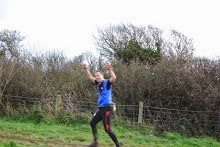
Just enough energy left for a smile and 2 thumbs up.
I'd had an amazing race, still didn't quite know how long I'd taken (having forgotten to start my watch until nearly 2 miles in), and was actively thinking about the beer at the Royal Castle.  I finally crossed the line in 5:15:50, my fastest CTS time yet, exhausted, exuberant, and buzzing with amazement at a day when everything came together.  As an added bonus, I finished with all toenails still intact!
What a race!

What a race?!
Days like that don't come along very often.  When the weather, the body, the mind, and the course are in sync, there really is no better feeling in running.  I may spend years chasing another day like it - but that's all part of the fun, isn't it?

Saturday, 5 February 2011

2011 Race Schedule

Now that it's February, I figured it was time to plan my fast Autumn marathon, so I didn't just have to select from whatever had places left.  Then, I could work back into the Summer and sort out my tune-ups and fit things in around the Summer's holidays.  As a result, I've selected the Abingdon Marathon for my next PB attempt.  It has the reputation of being pretty quick and the added bonus that it requires no air travel or overnight stay, so is fairly cheap.  Given the amount of time I'm spending away for the Spring races, I also think it might be nice to spare my neighbours yet another weekend of cat-sitting!  Happy Racing!